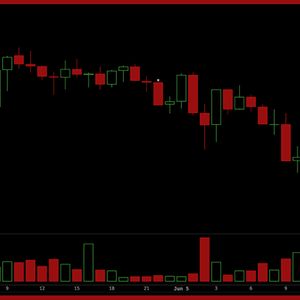
Summary Bitcoin (BTC-USD) faces renewed downside risk as Strategy (MSTR) begins selling its significant BTC holdings after 41 months of accumulation. MSTR’s potential for further sales, given its 4.2% share of all mined BTC, could exert substantial selling pressure and amplify price declines. Valuation metrics like the NVT ratio suggest BTC is historically expensive, while TAM analysis implies limited future adoption and a slow grind lower. With faith in BTC waning and its explosive growth era over, the asset now appears mature, fully penetrated, and unlikely to deliver superior returns. Bitcoin ( BTC-USD ) took a substantial dip recently when Strategy ( MSTR ) revealed that it had sold some of its BTC for the first time in 41 months. The company sold 32 Bitcoin when BTC traded at $77,000 . Although the sale was not large as a percentage of MSTR’s total Bitcoin holdings, the news shook many Bitcoin holders, who saw Strategy’s holdings as a backstop of the cryptocurrency’s value. Strategy's sales come after a period of considerable weakness for Bitcoin. At the time of this writing, the cryptocurrency was down 36% year-to-date (that may change by the time you see the article), and was trending lower. There are many reasons why Bitcoin’s price may be falling right now, but the biggest one is sentiment. Head anywhere that stocks and crypto are discussed, and you’ll see people questioning whether Bitcoin is really useful, really has intrinsic value, or really is a store of value. And in most cases, those asking the question are not so sure of the answer. The truth is that Bitcoin cannot be valued according to normal methods. As a digital currency, it does not generate cash flows. So, discounted cash flow [DCF] valuation is out where Bitcoin is concerned. You might think that no-arbitrage currency valuations could be used to value Bitcoin. But as a currency not backed by a central bank, Bitcoin also doesn’t have a set interest rate or stable foreign exchange trading band. So, it can’t really be valued using normal currency valuation methods either. Nevertheless, there are ways of approaching Bitcoin’s “true” value, and most of them do not point to the current level being the lowest that BTC could possibly go to. On the contrary, several imply that Bitcoin could go lower. This is a major conundrum. On the one hand, Bitcoin does not have intrinsic value going by conventional securities valuation techniques. On the other hand, it appears to be overvalued going by the unorthodox valuation methods that Bitcoin fans advocate. This isn’t exactly a recipe for optimism about the returns that Bitcoin holders will earn in the future. Speaking of Bitcoin’s returns: One of the main arguments that Bitcoin fans use to support their bullish theses on the coin, is the fact that it has performed so well since inception. Since being invented in 2009, Bitcoin has gone from near-zero (i.e. pennies) all the way to $66,000. Assuming the starting value was $0.01, then that’s a 190% CAGR return–certainly among the best of any asset in the 2009-2026 period. But more recent history reveals a different trend. Bitcoin is actually down over the last 12 months, and underperforming over the last five years . The days of BTC as a driver of explosive returns are long gone. Bitcoin underperforming the S&P 500 (Seeking Alpha Quant) When I last covered Bitcoin , I wrote that the cryptocurrency was subject to immense uncertainty owing to the lack of good methods for valuing it. I thought it was something of a dice roll. Since then, my knowledge of Bitcoin valuation methods has improved, and I now actually think there’s a case to be made for the coin having more downside from here. I will elucidate on this thesis in the ensuing paragraphs. How Saylor’s Sales Could Drive More Losses Before going any further, I should explain one potential cause of continued downside in Bitcoin, that being further selling by Strategy. CEO Michael Saylor said that Strategy would continue to sell Bitcoin if doing so would strengthen the company’s financial position. This was interpreted as Saylor pivoting to active management of Strategy’s balance sheet. Truthfully, active management would probably be a positive for Strategy itself–it would strengthen the company’s balance sheet in a scenario where Bitcoin went lower. The lower Bitcoin goes, the lesser the asset side of Strategy’s balance sheet, and the higher the company's ratio of debt to equity. So, selling Bitcoin periodically could help Strategy. The problem is that the more Strategy does this, the more selling pressure there is on Bitcoin. Strategy currently owns 843,706 Bitcoin. To date, 19.95 million Bitcoin have been mined. Therefore, Strategy owns 4.2% of all the Bitcoin that exists. This is a non-negligible percentage, meaning that Strategy heavily selling Bitcoin could move Bitcoin’s price. The percentage by which it could move the price is actually greater than 4.2%. The price of an asset is not determined by all of that asset being on offer at all times; it comes from the amount sold vs amount demanded at a given moment. Lately about 26,000 Bitcoin have been exchanging hands daily. Were Strategy to start selling a sizeable percentage of that amount, then it would move Bitcoin's price significantly. And the company could sell a sizeable percentage of the daily volume. Strategy has over 800,000 Bitcoin in its arsenal. It could offer many of those for sale in a single day. I'm not saying that Strategy will in fact start selling Bitcoin in size--Saylor did say he'd buy 10 or 20 Bitcoin for every one he sells after all. But it's factually established that he has enough Bitcoin to sell price-moving amounts of it. If Michael Saylor felt that his company's financial future were in jeopardy, he'd have the option of selling large amounts of Bitcoin to patch up his balance sheet. We can't rule out the possibility of him doing so in a scenario of continued Bitcoin price declines. Further, it's not clear that Saylor would be able to get enough financing to meaningfully offset a really large Bitcoin sale by buying more Bitcoin at a later date. Were Bitcoin to sell off severely, by high percentages, then lenders might become hesitant to lend money to Strategy, a company that is by and large a Bitcoin proxy. Given this, Saylor's stated intent of buying 10-20 Bitcoin for every one he sells, is not necessarily indicative of what will actually happen going forward. Valuation Having looked at a possible downside catalyst for Bitcoin, we can now move on to valuation. In previous articles, I wrote that this was essentially impossible because Bitcoin produces no cash flows. I still think there is no economically rigorous way to value Bitcoin. However, after researching the matter further, I’ve found that there are some metrics indicating how expensive Bitcoin is relative to historical norms. These can’t produce a “target” price, but they can shed light on Bitcoin’s value relative to transactions. The first of those is the network value to transactions [NVT] ratio , often called the P/E ratio of cryptocurrency. This measures how the actual usage of Bitcoin relative to its market cap. As the chart below shows, this ratio has been trending up since 2022, albeit erratically (the blue line is the ratio). From early 2022 to today, the ratio has gone from 9.8 to about 35. This indicates that Bitcoin has gotten more expensive in this period. Bitcoin NTV ratio (blockchain.com) Another approach we could use to value Bitcoin is to measure its total addressable market [TAM]. This approach is a little more subjective, because nobody knows exactly what the maximum userbase for Bitcoin is. We do, however, know that 95% of Bitcoin that will ever be mined, have been mined, so the supply side of the equation is near certain. If we knew the exact TAM then we could come up with a price target, too. I can’t put an exact number on Bitcoin’s TAM; however, Gallup reports that almost all American adults know what Bitcoin is, but only 14% own it . This would seem to imply that 86% of Americans are more or less content with conventional bank-based finance. The 14% who own BTC are presumably a mix of speculators and black market actors. It would seem that the potential for Bitcoin's TAM to increase in the United States is severely limited. As mentioned previously, polling shows that the overwhelming majority of Americans know what Bitcoin is, and only 14% have adopted it. The logical conclusion here is that the overwhelming majority of Americans are knowingly choosing not to adopt Bitcoin. With banks and credit card networks generally functioning well this year, it's hard to see what could get them to change their minds on this--why fix what isn't broken? So Bitcoin adoption in the United States appears unlikely to increase much. Global markets are a different story. Many countries in the global south still aren't widely connected to the internet--they could become a source of Bitcoin TAM growth. It's hard to put a precise timeline on such countries coming online, though, and some of their governments might ban Bitcoin. So, assuming a big, sudden increase in Bitcoin's TAM from developing countries appears an unwarranted assumption. The increase might never come, and would likely take a long time to materialize if it did come. With that said, TAM based valuation models are notoriously imprecise. It’s especially hard to guess the TAM for an asset whose users are anonymous. A large holder–let’s say Strategy–could easily push Bitcoin’s price down more than what I'm predicting. But it’s hard to predict that one of them will do so. The assumption of Bitcoin’s TAM already being addressed, and its supply slowly increasing from mining activities, points to a slow grind lower for BTC. The Bottom Line The bottom line on Bitcoin is that it is a mature asset at this point, and can no longer be counted on to deliver superior returns like it did in its early days. At this point, most people have heard of Bitcoin and decided whether or not they need it. The TAM would appear to be penetrated, or near-penetrated. On top of that, even known crypto “whales” like Michael Saylor’s Strategy are selling. Faith in this project appears to be waning, and in crypto, faith is everything.