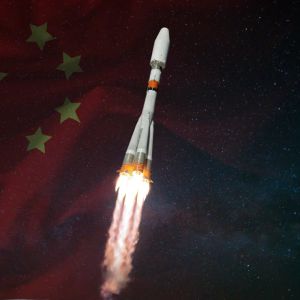
China has successfully launched its fourth reusable spacecraft mission since the program in 2020. The unmanned spaceplane is launched by a Long March-2F rocket that returns to Earth by landing on a runway. Both China and the U.S. are making advancements in space technology as they frequently launch unmanned, robotic spaceplanes on missions. China successfully launches fourth reusable spacecraft mission A Long March-2F carrier rocket lifted off from the Jiuquan Satellite Launch Center in the Gobi Desert of northwest China carrying a reusable experimental spacecraft into orbit for the fourth time since the program began in 2020. The state news agency Xinhua reported that the mission is intended to carry out “technological verification.” The spacecraft will test specific tools and systems that allow it to be used multiple times with the goal of providing technical support for what China calls the “peaceful use of outer space.” By using reusable technology, a country can significantly lower the cost of reaching orbit. China has not released official photos or technical specifications of the vehicle, but it is widely believed to be an unmanned spaceplane. The project has been nicknamed “Shenlong” by Chinese fans, which means “Divine Dragon.” China’s “Shenlong” first mission launched on September 4, 2020, and stayed in space for only two days before returning to a designated landing site. The second mission, launched in August 2022, stayed in orbit for 276 days before landing in May 2023. The third mission was in December 2023 and lasted for 268 days, returning in September 2024. During these missions, observers noticed the spacecraft releasing small objects into orbit, which experts believe were smaller satellites used to test maneuvers and communication. How does the “Divine Dragon” compare to the American X-37B? The “Shenlong” is often compared to the U.S. Space Force’s X-37B Orbital Test Vehicle as both are unmanned, robotic spaceplanes that launch vertically on a rocket but land horizontally on a runway like a traditional airplane. The U.S. recently concluded its seventh X-37B mission (OTV-7) in March 2025. The mission lasted 434 days and tested “aerobraking” maneuvers, which use the Earth’s atmosphere to change orbits without using much fuel. Just one day before China’s February 7 launch, the U.S. Space Force was scheduled to launch its eighth mission (OTV-8) using a SpaceX Falcon 9 rocket. The U.S. X-37B is roughly 9 meters long, while the Chinese “Shenlong” is estimated to be about 10 meters long. Both vehicles operate in “Low Earth Orbit,” but the U.S. version has demonstrated the ability to fly in much higher, elliptical orbits. Earlier this week, Chinese state media released a concept video for a project called “Luanniao,” a massive “space carrier” intended for the distant future. China also reported the first flight of a new electric vertical takeoff and landing (eVTOL) aircraft on February 6, 2026. It was developed by the Ninth Academy of the China Aerospace Science and Technology Corporation, and can carry two passengers at 150 kilometers per hour. China’s next major lunar mission, Chang’e 7, is expected to launch later in 2026 to search for water ice at the lunar south pole. NASA’s Artemis II mission is also currently scheduled to send four astronauts on a loop around the Moon in early 2026. Want your project in front of crypto’s top minds? Feature it in our next industry report, where data meets impact.