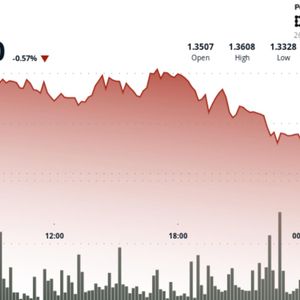
BitcoinWorld New Zealand Dollar Slides as Risk Aversion Grips Global Markets The New Zealand Dollar (NZD) has weakened against major counterparts, particularly the US Dollar, as a broad wave of risk aversion sweeps through global financial markets. Investors are moving away from growth-sensitive currencies like the Kiwi, seeking the relative safety of the greenback and other traditional safe havens. Risk-Off Sentiment Drives the Move The decline in NZD/USD is primarily attributed to a deterioration in global risk appetite. Renewed concerns over geopolitical tensions, mixed economic data from key trading partners like China, and uncertainty surrounding central bank policy trajectories have prompted investors to reduce exposure to higher-yielding, commodity-linked currencies. The New Zealand Dollar, often viewed as a barometer for global risk sentiment due to the country’s reliance on trade and commodity exports, is particularly sensitive to these shifts. Market Context and Technical Picture From a technical perspective, NZD/USD has broken below key support levels, accelerating the sell-off. The pair is now testing levels not seen in recent weeks, with traders eyeing further downside if risk sentiment continues to sour. The Reserve Bank of New Zealand’s (RBNZ) recent dovish stance, signaling potential rate cuts amid a slowing domestic economy, has further undermined the currency’s appeal. In contrast, the US Dollar has strengthened on expectations that the Federal Reserve may maintain higher interest rates for longer, widening the interest rate differential in favor of the USD. Implications for Traders and Importers For forex traders, the current environment favors short positions on the NZD against the USD and other safe-haven currencies like the Japanese Yen. However, volatility remains elevated, and any unexpected positive developments could trigger sharp short-covering rallies. For New Zealand-based importers, a weaker NZD means higher costs for goods priced in foreign currencies, potentially feeding into domestic inflation pressures. Conversely, exporters may benefit from increased competitiveness abroad. Conclusion The New Zealand Dollar’s decline is a textbook reaction to rising risk aversion, compounded by domestic economic headwinds and a hawkish Federal Reserve. The currency’s near-term trajectory will likely hinge on the evolution of global risk sentiment and any fresh catalysts from economic data or central bank communications. Traders should remain cautious and monitor key support levels for potential further downside. FAQs Q1: Why is the New Zealand Dollar falling? The NZD is declining primarily due to increased global risk aversion, which drives investors away from growth-sensitive currencies. Additionally, a dovish RBNZ and a strong US Dollar are contributing to the weakness. Q2: What is risk aversion in currency markets? Risk aversion refers to a market environment where investors prefer safe assets (like the US Dollar, Japanese Yen, or gold) over riskier, higher-yielding assets (like the NZD, AUD, or emerging market currencies) due to uncertainty or fear. Q3: How does a weaker NZD affect the New Zealand economy? A weaker NZD makes imports more expensive, which can fuel inflation, but it also boosts the competitiveness of New Zealand’s exports, potentially supporting the trade sector and economic growth. This post New Zealand Dollar Slides as Risk Aversion Grips Global Markets first appeared on BitcoinWorld .